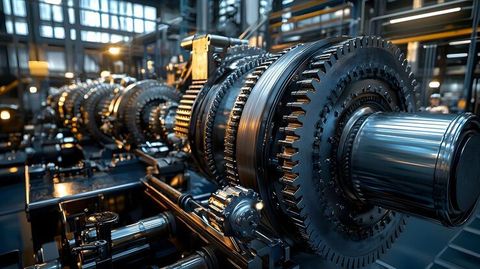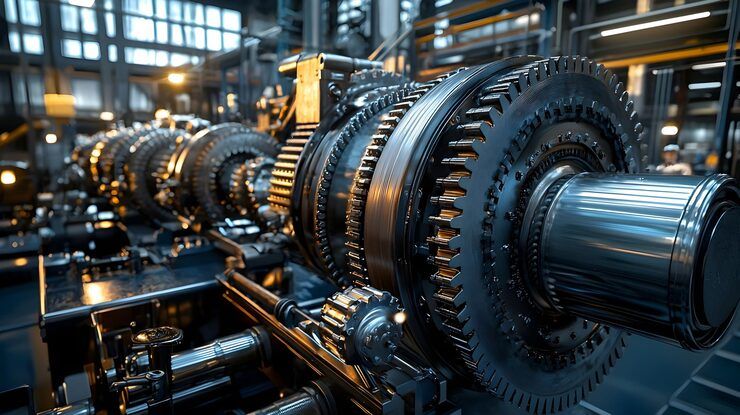
Industrial gearbox design is the process of developing a mechanical system that transfers rotational power between a driving machine and a driven machine.
It involves selecting gears, shafts, bearings, housings, lubrication methods, and other components according to operating requirements.
A well-planned industrial gearbox design considers factors such as torque, speed, load, efficiency, operating environment, heat generation, and expected duty cycle. Understanding these principles helps engineers, technicians, students, and equipment users better understand how industrial gear systems function.
Context
An industrial gearbox is a mechanical transmission system used to change rotational speed and torque. It normally receives power from a motor, engine, or another rotating source and transmits that power to equipment such as conveyors, mixers, crushers, pumps, compressors, lifting systems, and processing machinery.
The basic purpose of a gearbox is to establish a suitable relationship between input speed and output speed. When speed is reduced through gearing, output torque can generally increase, although actual performance depends on gear ratios, efficiency, losses, and operating conditions.
Industrial gearbox design begins with defining the operating requirements. Important design inputs include:
- Input power and rotational speed
- Required output speed
- Output torque
- Duty cycle
- Load characteristics
- Operating temperature
- Installation arrangement
- Space limitations
- Expected operating life
- Environmental conditions
Gearboxes can use different gear arrangements. Common types include spur, helical, bevel, worm, planetary, and cylindrical gear systems. Each arrangement has different characteristics related to efficiency, load capacity, noise, size, and speed reduction.
Importance
Industrial gearbox design affects the reliability and performance of many mechanical systems. Incorrect selection or inadequate design can contribute to excessive vibration, overheating, gear wear, shaft failure, bearing damage, or unexpected equipment shutdown.
The gear ratio is one of the fundamental design considerations. It describes the relationship between input and output rotational speeds. For a simple reduction gearbox, a higher reduction ratio generally produces a lower output speed and a higher theoretical torque multiplication.
However, gearbox design involves more than selecting a ratio. Engineers must consider how forces move through the gears and shafts. Radial and axial forces can affect bearing selection, while transmitted torque influences shaft dimensions and gear strength.
| Design element | Main consideration | Typical purpose |
|---|---|---|
| Gears | Load, speed, material | Transfer rotational motion |
| Shafts | Torque and bending | Carry rotating components |
| Bearings | Radial and axial loads | Support rotating shafts |
| Housing | Strength and alignment | Enclose and support components |
| Lubrication | Temperature and gear speed | Reduce friction and wear |
| Seals | Environment and lubricant | Help contain lubricant |
| Cooling | Heat generation | Control operating temperature |
Material selection is another important part of industrial gearbox design. Gear materials may be selected according to strength, hardness, fatigue resistance, manufacturing requirements, and operating conditions. Heat treatment can also influence surface hardness and durability.
Recent Updates
Modern gearbox development increasingly combines conventional mechanical engineering with digital analysis and monitoring technologies. Computer-aided design and engineering tools allow designers to examine gear geometry, shaft loads, housing structures, and thermal behavior before physical production.
Simulation techniques can help evaluate stress concentrations, deformation, vibration, and heat transfer. Finite element analysis is commonly used for components where structural behavior needs detailed examination.
Condition monitoring is also becoming more common in industrial transmission systems. Sensors can collect information about:
- Vibration
- Temperature
- Rotational speed
- Lubricant condition
- Acoustic behavior
- Operating load
This information can support condition-based maintenance by helping technical teams identify changes in equipment behavior.
Another development is the use of compact planetary gear arrangements. Planetary systems can provide substantial reduction ratios within relatively compact packages while distributing loads across multiple gears. Their application depends on the required torque, speed, geometry, and operating conditions.
Digital twins and data-based engineering methods are also being explored for industrial equipment. These approaches can combine equipment models with operational information to study performance and maintenance conditions.
Laws or Policies
Industrial gearbox design may be influenced by engineering standards, workplace safety requirements, machinery regulations, and environmental rules. The specific requirements depend on the country, industry, machine type, and installation environment.
International standards organizations publish guidance related to gears, mechanical power transmission, vibration, lubrication, and machinery safety. ISO standards are commonly referenced in international engineering work, while organizations such as ASME and AGMA publish technical standards and guidelines relevant to mechanical transmission systems.
In the United States, machinery installations may also be affected by Occupational Safety and Health Administration requirements and applicable electrical and mechanical safety provisions. In the European Union, machinery placed on the market or put into operation may be subject to applicable machinery legislation and harmonized standards.
For industrial projects in India, designers may need to consider applicable Bureau of Indian Standards publications, occupational safety requirements, factory regulations, and sector-specific rules.
Standards should be checked using their current official editions because requirements can change. Engineers should also distinguish between mandatory legal requirements and voluntary technical standards adopted as part of a project specification.
Tools and Resources
Several engineering resources can help with industrial gearbox design and analysis. The appropriate tool depends on the design stage and the level of accuracy required.
Design and calculation resources
Common resources include:
- Gear ratio calculators for preliminary speed relationships
- Torque and power calculations for transmission sizing
- CAD software for component and assembly modeling
- Finite element analysis tools for structural evaluation
- Gear geometry software for tooth calculations
- Bearing selection tools for load and life estimation
- Thermal calculations for heat-generation assessment
- Technical standards for design and verification
A basic power relationship can be used to understand the relationship between torque and rotational speed:
Power is related to torque multiplied by angular velocity.
For preliminary engineering calculations, this relationship helps establish the approximate torque associated with a particular motor power and rotational speed. Actual gearbox performance must also account for transmission losses and efficiency.
Manufacturer technical catalogs and engineering handbooks can provide useful reference information about gear geometry, bearing arrangements, lubrication approaches, materials, and operating limits. These resources should be used alongside applicable engineering standards rather than as a substitute for detailed design verification.
FAQs
What is industrial gearbox design?
Industrial gearbox design is the engineering process of determining the gear arrangement, ratio, materials, shafts, bearings, housing, lubrication, and related features required for a particular mechanical transmission application.
How is a gearbox ratio determined?
The ratio is generally established from the required relationship between input and output speed. Additional factors such as torque, load behavior, efficiency, and operating conditions must also be considered.
Which parts are found in an industrial gearbox?
Common parts include gears, shafts, bearings, housing, seals, keys or splines, lubrication components, and sometimes cooling or monitoring equipment.
Why is lubrication important in gearbox operation?
Lubrication helps control friction, heat, and wear between moving components. The lubricant type, quantity, viscosity, and operating temperature should be appropriate for the gearbox design and application.
What factors affect gearbox life?
Gear loading, alignment, lubrication, temperature, contamination, vibration, operating speed, material selection, manufacturing accuracy, and maintenance practices can all influence gearbox operating life.
Conclusion
Industrial gearbox design combines gear theory, mechanical strength calculations, material selection, thermal considerations, lubrication, and structural analysis. The objective is to create a transmission system that can handle its specified speed, torque, load, and operating environment.
Modern design methods increasingly use computer modeling, simulation, sensors, and condition monitoring to understand gearbox behavior. Even with these technologies, fundamental engineering principles and applicable standards remain important for developing reliable mechanical transmission systems.
Understanding the individual parts and their relationships makes it easier to study industrial gearboxes and evaluate their operating behavior. Engineers and technical users should always verify application-specific requirements before selecting or designing a gearbox for industrial equipment.