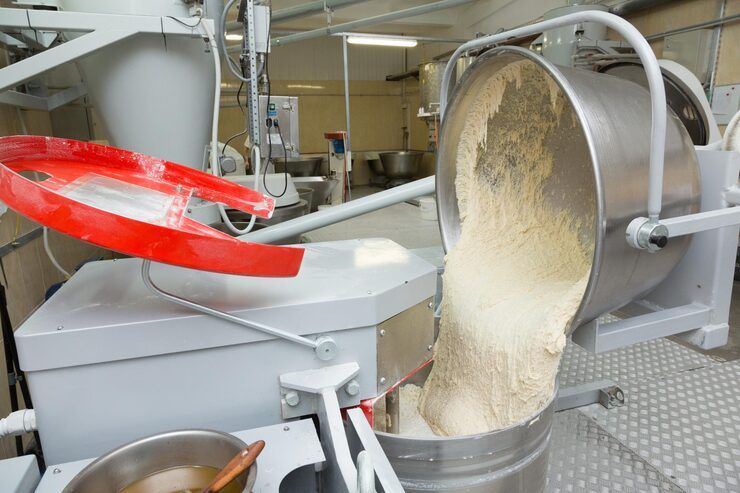
Dough machines are important pieces of equipment in bakeries, food production facilities, restaurants, and other food-processing environments. They help mix, knead, divide, shape, or otherwise prepare dough for products such as bread, pizza, pastries, cookies, and other baked foods.
Commercial and industrial dough equipment varies considerably in size, capacity, design, and automation. Understanding the basic machine types, operating principles, safety considerations, regulations, and recent technology developments can help readers better understand how dough processing fits into modern food production.
Context – Understanding Dough Machines
A dough machine is equipment designed to perform one or more stages of dough preparation. The most common example is a dough mixer, which combines ingredients and develops the desired dough structure through controlled mechanical action.
Commercial equipment is generally intended for bakeries, restaurants, hotels, food establishments, and medium-scale production environments. Industrial equipment is usually designed for continuous or high-volume production and may form part of an integrated processing line.
Common dough equipment includes:
| Equipment type | Main function | Typical application |
|---|---|---|
| Spiral mixer | Mixing and kneading | Bread and pizza dough |
| Planetary mixer | Mixing several formulations | Bakeries and food preparation |
| Horizontal mixer | Large-batch mixing | Industrial bakery production |
| Dough divider | Dividing dough portions | Bread and roll production |
| Dough rounder | Forming rounded portions | Rolls and buns |
| Dough sheeter | Flattening dough | Pastry and laminated products |
| Dough molder | Forming dough pieces | Bread and specialty products |
The correct machine depends on dough characteristics, batch size, recipe requirements, production frequency, available floor space, cleaning procedures, and the desired level of automation.
Importance – Why Dough Equipment Matters
Dough preparation can influence the texture, structure, weight, appearance, and consistency of baked products. Mixing time, ingredient distribution, dough temperature, and mechanical action can all affect how dough behaves during later processing.
For smaller bakeries, equipment selection may focus on batch flexibility and straightforward operation. Larger facilities may require automated systems that connect mixing with dividing, rounding, proofing, forming, and baking.
Important considerations include:
- Dough type and hydration
- Batch capacity
- Mixing speed and control
- Dough temperature
- Cleaning and sanitation
- Operator safety
- Available production space
- Compatibility with other equipment
- Maintenance requirements
Equipment should also match the characteristics of the recipes being processed. A machine designed primarily for soft dough may not be appropriate for a dense or highly developed dough formulation.
Recent Updates – Trends in Dough Technology
Recent developments in bakery production increasingly involve automation, connected equipment, data collection, robotics, and improved process monitoring. Industry discussions in 2025 and 2026 have highlighted the growing use of digital controls, predictive maintenance, collaborative robotics, and data-driven dough analysis.
One important development is the use of dough-behavior data. Modern testing approaches can measure characteristics such as consistency and ingredient interactions, giving production teams additional information for controlling variations in dough processing.
Automation is also becoming more flexible. Instead of automating an entire bakery line at once, some facilities are focusing on repetitive activities such as dough handling, tray movement, forming, and other production stages. Industry reports also identify workforce training, hygienic design, documentation, and flexible automation as important considerations.
AI and connected sensors are another developing area. These technologies can help collect equipment data and identify unusual operating conditions. However, current industry reporting also notes that older equipment, fragmented data, and skills gaps can make implementation more complicated.
Laws or Policies – Safety and Regulatory Considerations
Dough equipment must be considered within the food-safety and workplace-safety rules applicable to the location where it operates. Requirements differ between countries and may also differ between commercial kitchens, bakeries, factories, and other workplaces.
In the United States, OSHA's machine-guarding requirements address hazards created by rotating parts, points of operation, and other moving components. OSHA specifically identifies commercial dough mixers as equipment requiring appropriate safeguarding.
Cleaning, maintenance, and blockage removal also require attention. OSHA guidance for food-processing equipment emphasizes appropriate guarding and safe procedures when workers may be exposed to moving machinery or hazardous energy.
Food-contact materials are another consideration. The FDA Food Code 2026 states that food-contact surfaces should be safe, durable, corrosion-resistant, nonabsorbent, smooth, and easily cleanable under the specified conditions.
In the European Union, Regulation (EU) 2023/1230 establishes machinery safety requirements and is scheduled to apply from January 20, 2027, with certain provisions applying earlier. Businesses placing machinery on the EU market should therefore check the applicable transition and conformity requirements.
Because requirements vary by jurisdiction and equipment configuration, manufacturers and operators should consult the applicable official regulatory authorities and current technical documentation.
Tools and Resources – Useful Information Sources
Several types of resources can help readers understand dough machines and bakery equipment more effectively.
Useful resources include:
- Manufacturer technical manuals for operating and cleaning instructions
- Equipment specifications for capacity and electrical requirements
- OSHA guidance for workplace machine guarding
- FDA Food Code resources for food-contact equipment considerations
- EU machinery legislation through EUR-Lex
- Bakery industry publications for technology developments
- Dough testing information for understanding dough characteristics
- Equipment maintenance records and inspection checklists
A useful comparison worksheet can include machine type, batch capacity, dough formulation, mixing method, speed controls, sanitation requirements, safety features, power requirements, footprint, and compatibility with existing production equipment.
The purpose of such a worksheet is to organize technical information rather than promote a particular machine or manufacturer.
FAQs – Dough Machine Questions
What is a dough machine?
A dough machine is mechanical equipment used to perform tasks such as mixing, kneading, dividing, rounding, sheeting, or forming dough. The exact function depends on the machine design.
What is the difference between commercial and industrial dough equipment?
Commercial dough equipment is commonly used in restaurants, bakeries, hotels, and other food establishments. Industrial equipment is generally designed for larger production volumes and may integrate with automated processing lines.
What should be considered when studying dough mixer specifications?
Important factors include dough type, batch size, mixing method, speed control, bowl capacity, dough temperature, sanitation requirements, electrical specifications, safety features, and compatibility with the production process.
Are dough mixers subject to workplace safety rules?
Yes. Applicable workplace regulations can require safeguards around moving machinery. In the United States, OSHA has specific machine-guarding requirements relevant to commercial dough mixers and other food-processing equipment.
How is technology changing dough processing?
Modern systems increasingly use digital controls, sensors, data collection, automation, robotics, and dough-analysis technologies. These developments are intended to improve process monitoring and consistency, although implementation can require suitable data systems and operator training.
Conclusion – Dough Equipment Overview
Dough machines range from compact commercial mixers to highly integrated industrial processing systems. Their functions can include mixing, kneading, dividing, rounding, sheeting, and forming, with the appropriate configuration depending on the dough, production process, and operating environment.
Recent developments are bringing more automation, digital monitoring, robotics, and data-based process control into bakery production. At the same time, machine guarding, food-contact materials, sanitation, operator training, and local regulatory requirements remain important parts of responsible equipment use.
Understanding the basics of dough equipment provides a useful foundation for comparing machine functions and production methods. Readers should use current technical documentation and official regulatory sources when evaluating specific equipment or operating requirements.