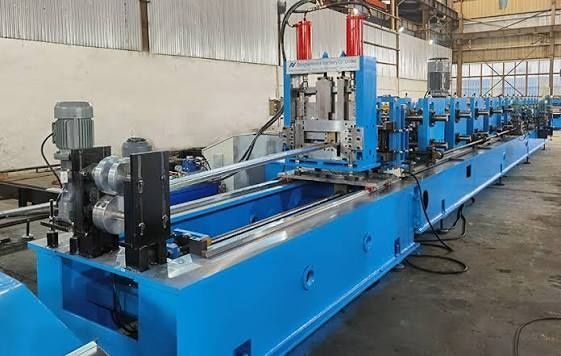
A purlin machine is industrial equipment used to form structural profiles from metal strip or sheet material. Purlins are commonly used as horizontal structural members in roofing and wall systems, where they help support panels and transfer loads to the main structural frame.
Understanding purlin machine basics involves learning about profile shapes, material selection, forming stages, dimensional accuracy, and production processes. This guide explains these fundamentals in simple terms for readers who want to understand how purlin manufacturing works.
Context
Purlins are structural members typically positioned between the main frames of a building. Common profiles include C, Z, and related formed sections. Their shape provides structural strength while keeping the section relatively lightweight compared with some solid structural members.
A purlin machine generally uses a roll-forming process. In this process, a continuous metal strip passes through a series of rollers. Each roller station gradually changes the shape of the material until the required profile is achieved.
The basic production sequence usually includes:
- Loading the metal coil.
- Feeding the strip into the forming line.
- Guiding and aligning the material.
- Gradually forming the profile through roller stations.
- Cutting the finished section to a specified length.
- Collecting and checking the completed profiles.
Different machines can have different configurations depending on profile dimensions, material specifications, production requirements, and the level of automation involved.
Purlin profiles are generally identified by their cross-sectional geometry. C purlins have a C-shaped cross section, while Z purlins have a Z-shaped configuration. Some systems can produce multiple sizes by changing forming components or adjusting machine settings.
| Purlin Profile | General Shape | Common Application | Key Characteristic |
|---|---|---|---|
| C Purlin | C-shaped | Roofing and wall framing | Simple section geometry |
| Z Purlin | Z-shaped | Roofing structures | Useful for overlapping arrangements |
| Sigma Profile | Modified structural shape | Selected structural applications | Increased geometric efficiency |
| Custom Profile | Application-specific | Specialized structures | Designed around project requirements |
Material selection is another important part of purlin machine basics. Galvanized steel is widely used because its zinc coating provides protection against corrosion. Structural-grade carbon steel and other coated steel products can also be used when their mechanical and dimensional specifications match the intended application.
Importance
Purlin machines matter because the forming process affects the dimensions, shape, and consistency of structural profiles. A correctly formed purlin needs to maintain its specified geometry so that it can be incorporated into the intended structural system.
Manufacturers, engineers, construction professionals, and quality-control teams may all need knowledge of purlin production. Engineers are particularly concerned with structural requirements, while production teams focus on forming accuracy and process control.
Several factors influence the performance of a purlin production process:
- Material thickness and grade
- Coil width and surface condition
- Profile dimensions
- Roller alignment
- Forming sequence
- Cutting accuracy
- Production speed
- Dimensional inspection
Material thickness is especially important. If the input material differs from the specified thickness, the finished profile may not have the expected mechanical characteristics.
The forming process also needs to avoid unnecessary distortion. Excessive deformation, incorrect roller alignment, or unsuitable forming parameters can result in twisting, bowing, surface marks, or dimensional variation.
Quality checks can include measurements of profile depth, flange width, lip dimensions, overall length, straightness, and material thickness. Depending on the application, additional inspection may be required according to the applicable structural standard.
Recent Updates
Recent developments in purlin machine technology have focused on automation, flexibility, monitoring, and process consistency. Modern roll-forming systems can incorporate programmable controls, automated length measurement, digital interfaces, and integrated cutting systems.
One notable development is the use of adjustable tooling arrangements. These systems can support production of different profile dimensions without requiring an entirely separate production line for every profile.
Digital controls can also help operators configure parameters such as profile dimensions, production length, and forming settings. Automated measurement and cutting can reduce dependence on manual measurements during routine production.
Another development is greater attention to production data. Sensors and control systems can monitor selected operating conditions and provide information that can help identify deviations during manufacturing.
Energy efficiency is also becoming an important consideration in industrial equipment design. Manufacturers of forming equipment may focus on efficient motors, improved transmission systems, and optimized production cycles.
Material technology continues to develop as well. High-strength steels can provide different structural characteristics from conventional grades, but the forming process must be appropriate for the selected material. Higher-strength material may require careful control of roller geometry and forming parameters.
Computer-aided engineering and simulation can also support profile development. Before physical production, engineers can study how a proposed section behaves under structural loads and how its geometry can be produced through a roll-forming sequence.
Laws or Policies
Purlin production can be affected by several categories of regulations and technical standards. The exact requirements depend on the country, building type, material specification, and intended structural application.
In the United States, structural steel design and related requirements may involve standards developed by organizations such as the American Iron and Steel Institute (AISI) and the American Society of Civil Engineers (ASCE).
In Europe, structural steelwork can be governed by Eurocodes, including EN 1993 for steel structures. Product and material requirements can also involve relevant European standards.
In India, structural steel applications can involve Indian Standards published by the Bureau of Indian Standards (BIS). The applicable requirements depend on the particular structural product and building application.
Environmental and workplace rules may also apply to manufacturing facilities. These can address areas such as machinery safety, electrical systems, worker protection, noise, emissions, and industrial waste.
Because regulations vary by jurisdiction and can be updated, organizations should consult the current requirements issued by the relevant national standards bodies, building authorities, and workplace regulators.
Tools and Resources
Several resources can help readers learn more about purlin machine processes, structural profiles, and material requirements.
Useful resources include:
- AISI publications for cold-formed steel information
- BIS standards and publications for applicable Indian requirements
- Eurocodes for structural design principles in Europe
- ASCE publications for structural engineering guidance
- Manufacturer technical manuals for roll-forming equipment
- Structural design software for profile analysis
- Steel section tables and engineering references
- Unit-conversion and section-property calculators
A profile-selection worksheet can also help organize technical information before production. Important fields may include material grade, thickness, profile depth, flange dimensions, lip dimensions, required length, and applicable structural standard.
When using calculators or online references, users should verify that the underlying formulas and standards match their specific application. Engineering calculations for structural projects should be reviewed by appropriately qualified professionals.
FAQs
What is a purlin machine?
A purlin machine is equipment designed to continuously form metal strip into structural purlin profiles. It normally uses multiple roller stations to gradually create the required cross-sectional shape.
What materials are commonly used for purlins?
Galvanized steel and structural-grade steel are commonly used. The appropriate material depends on structural requirements, environmental exposure, thickness, mechanical properties, and applicable standards.
What are C and Z purlins?
C and Z purlins are two common cold-formed structural profiles. Their names describe their approximate cross-sectional shapes. Their selection depends on structural design, connection arrangements, span requirements, and project specifications.
How does purlin roll forming work?
A metal strip is fed through a sequence of rollers. Each station progressively bends the strip until it reaches the required profile. The formed section is then cut into predetermined lengths.
Why is dimensional accuracy important?
Dimensional accuracy helps ensure that manufactured purlins correspond with their specified geometry and can be used appropriately within the intended structural system. Incorrect dimensions can affect connections, alignment, and structural performance.
Conclusion
Purlin machine basics cover several connected areas, including profile geometry, material selection, roll-forming stages, cutting, dimensional inspection, and applicable standards. Understanding these elements provides a foundation for learning how C, Z, and other cold-formed structural profiles are manufactured.
Production requirements vary according to material, profile design, structural application, and regional standards. Technical specifications should therefore be established before manufacturing begins.
A clear understanding of the forming sequence can also help explain why roller alignment, material properties, and process control matter. For structural applications, engineering requirements and applicable regulations should always be considered alongside manufacturing considerations.